Projects
The support we deliver, thanks to your kind donations will affect communities all over the world. Initially while we grow, we might be able to help just a handful of small local causes, like supporting a family with a disabled child, purchasing a wheel chair for someone in need, or perhaps providing food for struggling families. As we grow (and have more donations at our disposal) our impact will increase. It's important to point out though that no matter who we help, YOU, as a donor have a vote on who that is. The more you donate, the louder your voice. Imagine what we could do with thousands of donors. Build schools, develop learning centres in developing countries, or even provide long term health support for hundreds of thousands of families all over the world. The opportunities are only limited to the donations you make.
We are still in our first year.
We deliver our first project in January 2022.

THE 100 MILE CLASSROOM
Project Overview:
Britain is one of the most nature-depleted countries in the world, with one in six species at risk of national extinction. Over half of UK secondary schools offer no outdoor learning at all, young people are spending far less time outside than previous generations, and fewer than one in three can explain what a "green job" is.
The 100 Mile Classroom led by the Knepp Wildland Foundation as part of Weald to Waves, is reimagining how young people connect with and learn from inspiring local nature restoration work. 100 miles of connected land, rivers and coastline across Sussex - are used as a living, outdoor classroom for young people aged 11-18. Rather than learning about ecological decline in abstraction, students encounter nature recovery as it happens around them, witnessing landscapes being repaired: scrub returning, rivers restored, hedges replanted. Learning is led and supported by trained Young Guides - young people who bring the landscape to life as relatable role models rather than distant experts.
Your £10,000 turns 3,000 young lives outward, toward rivers, woodland and coastline they might otherwise never have set foot in. Each school will be paired with a real, accessible site along the Weald to Waves corridor. These are students with the least access to nature and the most to gain from it - and thanks to you, every barrier of cost, logistics and opportunity that once stood in their way is gone. You're not just funding a school trip; you're planting the belief, in 3,000 young minds, that nature's recovery is something they can be part of - a legacy that will outlast the visit itself, rippling into the choices, careers, and communities of an entire generation.


Who will the project help?
The 100 Mile Classroom is designed for young people who currently have the least opportunity to connect with nature. Over half of UK secondary schools offer no outdoor learning at all, young people are spending far less time outside than previous generations, and fewer than one in three can explain what a “green job” is. The programme will work with 20 schools across the Weald to Waves corridor, engaging up to 3,000 young people, with a clear focus on state secondary schools in Crawley, and along the Sussex coast - areas that experience higher levels of social and economic deprivation, limited access to green space, and some of the highest youth unemployment rates in the county. By fully funding visits and linking schools to nearby, accessible sites, the programme removes the financial, social and logistical barriers that prevent many students from experiencing meaningful outdoor learning.
Regular engagement with nature delivers proven benefits: improved mental wellbeing, reduced anxiety, increased physical activity, stronger confidence and a deeper sense of belonging. At a time of rising eco-anxiety, the 100 Mile Classroom gives young people something vital - agency - by allowing them to witness recovery in action, not just environmental loss. The programme also supports teachers, who are under increasing pressure to deliver sustainability education without sufficient resources, while strengthening relationships between schools, landowners and conservation projects, helping nature recovery become part of everyday community life.
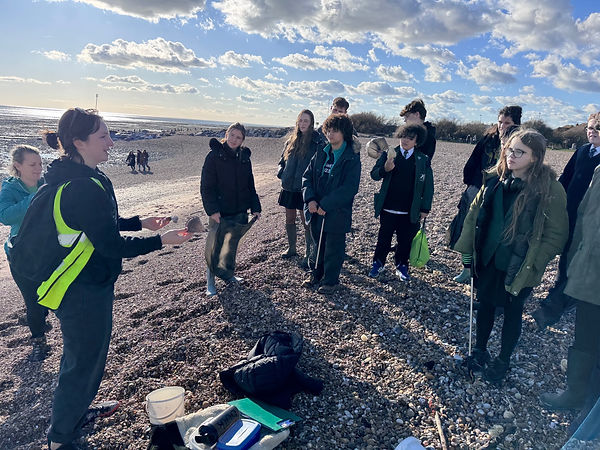
How will the project be delivered?
The 100 Mile Classroom turns Sussex itself into a living classroom, linking schools with real places where nature recovery is happening - from rewilding estates and farms to rivers, commons and community green spaces along the Weald to Waves corridor. Each school is paired with accessible local sites, making outdoor learning repeatable, inclusive and rooted in place.
Learning is led and supported by our trained Young Guides, who help deliver visits, share lived experience of nature recovery, and act as relatable role models for students. In the classroom, curriculum-linked resources and seasonal films bring these landscapes to life, connecting biodiversity, climate and land use.
By working with farmers, land managers, conservation partners and green employers, the programme also opens clear pathways into volunteering, work experience, training and future careers - creating a practical, scalable model for nature-connected education that can grow across Sussex and beyond.
The 100 Mile Classroom
PROJECT LIVE UPDATES
We have committed to transparently sharing the story of donors funds from voting process, to transfer, to regulations, to implementation, failings and successes. The process of development is not linear, but each step is powerful, and important.
We will update you every chance we get and bring you into the process that goes on both here with our 196 team, but also from Sussex and the 100 Mile Classroom Team
June 2026
Following the community vote, the 100 Mile Classroom was selected as one of this year’s project. The focus was clear: turns Sussex into a living classroom, where students witness nature recovery in action, from restored rivers to rewilded landscapes. By experiencing recovery first-hand, young people gain not just knowledge, but the belief that they can be part of the solution. Over the summer we worked closely with the team to allocate funding and define how the the programme would be delivered.
Stay tuned for more updates!
If you would like more information please email contact@the196foundation.com